
Guide to Picking Glasses That Suit Your Face Shape Perfectly
February 27,2023
What is Boho Style? A Comprehensive Guide to Boho-Chic Fashion
February 13,2025
Virtual Glasses Try On - Find Your Perfect Pair Online
April 02,2024
UV Protection vs. Blue Light Glasses: Understanding the Core Differences
July 20,2023
The Ultimate Guide to Modern Trendy Men's Glasses: Top Styles for 2026
March 01,2024
Stylish Reading Glasses: Blending Fashion with Functionality
February 16,2023
Photochromic Lenses 101: How They Work & Why You Need Them
September 22,2023
Brown Eyes: The Beauty of the Most Common Hue
September 01,2024
The chubby face glasses for round face female
August 02,2023
What are prisms in eyeglasses?
March 20,2023
What Are Bifocal Glasses? The Complete Guide (Types, History & Benefits)
April 14,2023
How to Read Your Eyeglass Prescription?
March 11,2023
Polarized vs. Photochromic Lenses: What's the Difference and Which Do You Need?
By Vooglam
Share this article

Picture driving down a coastal highway on a bright Saturday morning. The sun hits the ocean, sending a blinding reflection right into your eyes. Later that same afternoon, you are back in your dimly lit studio, staring at a monitor to edit digital photos. You need eyewear that effortlessly keeps up with your dynamic, creative rhythm. But when configuring your new custom frames, you hit a common roadblock.
Should you choose a dedicated polarized tint, or do you opt for a light-adapting photochromic coating? If you are entirely confused by the photochromic vs polarized lenses debate, you are far from alone. Many rational consumers struggle to understand which upgrade actually fits their daily lifestyle. In this comprehensive guide, we will break down the exact difference between polarized and photochromic technologies. Let's explore how to protect your vision, elevate your mood, and build an eyewear wardrobe that truly works for you.
- What Are Polarized Lenses? (The Glare Killers)
- What Are Photochromic Lenses? (The All-Day Adapters)
- The Ultimate Showdown: Polarized vs Photochromic Lenses
- The Driving Dilemma: Which Lenses Are Safer for Cars?
- Fusion Tech: Can You Have Both? (Photochromic Polarized Lenses)
- Conclusion: How to Make Your Choice at Vooglam
What Are Polarized Lenses? (The Glare Killers)
Imagine standing by a lake at high noon or driving on a wet road after a fresh rain. The light bouncing off those flat surfaces creates an intense, blinding glare. Standard tinted sunglasses simply darken your entire field of vision, but they do nothing to stop that harsh, scattered light. This is exactly where polarized lenses step in.
According to optical guidelines from the American Academy of Ophthalmology, polarized lenses feature a specialized chemical filter built directly into the lens. You can think of this filter like microscopic Venetian blinds for your eyes. It completely blocks horizontal light waves—the exact waves that cause blinding glare—while only allowing vertical light to pass through. By eliminating this visual noise, polarized lenses offer unmatched clarity and depth perception. They are the absolute best choice for intense water sports, snowy outdoor hikes, and long hours of daytime driving in the blazing sun.

Experience True Clarity: Discover Polarized Sunnies >>
What Are Photochromic Lenses? (The All-Day Adapters)
Now, imagine walking out of a cozy cafe and stepping directly onto a sun-drenched sidewalk. Instead of digging through your bag to swap your clear glasses for prescription sunglasses, your lenses instantly adapt to the changing light. These are photochromic lenses, and they rely on a brilliant UV-triggered mechanism.
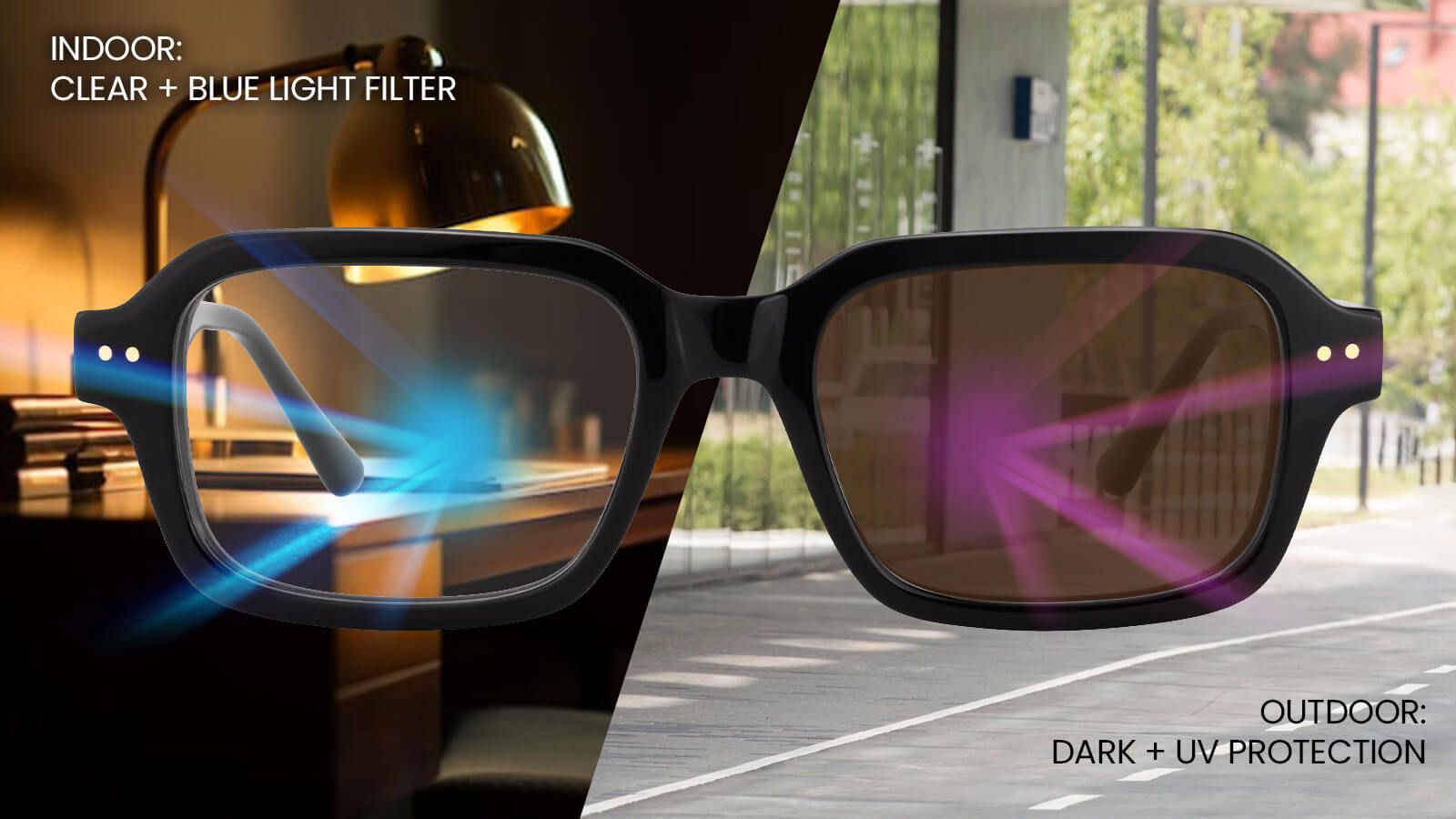
When exposed to the sun's invisible ultraviolet rays, trillions of photochromic molecules inside the lens physically change shape, absorbing the light and darkening the glass. Once you step back indoors, the UV rays vanish, and the lenses quickly fade back to a perfectly clear state. Today, the technology has reached an incredible new milestone. By upgrading to advanced options like Transitions® GEN S™, you get lightning-fast fading speeds. More importantly, these modern lenses actively filter harsh digital blue light while you are indoors. When comparing standard photochromic sunglasses vs polarized options, photochromic lenses act as the ultimate all-day, hybrid companion.

Upgrade to Transitions® GEN S™ Lenses for Lightning-Fast Fading >>
The Ultimate Showdown: Polarized vs Photochromic Lenses
To make the best choice for your unique aesthetic and lifestyle, we need to put these two brilliant technologies head-to-head in real-world scenarios.
Round 1: Visual Clarity and Glare
Winner: Polarized. While photochromic lenses beautifully darken to shield your eyes from bright ambient sunlight, they cannot physically cut through horizontal reflection. If you are staring at a shimmering lake or a glossy, wet highway, only a polarized lens will strip away that blinding glare to reveal the true details underneath.
Round 2: Everyday Convenience
Winner: Photochromic. Dedicated polarized sunglasses are strictly for the outdoors. The moment you walk into a grocery store or an office building, they become entirely too dark, forcing you to take them off. Photochromic lenses seamlessly bridge the gap. You can comfortably wear your favorite tasteful Vooglam frames from your morning coffee straight through to your evening commute.
Round 3: Digital Screens
Winner: Photochromic. Here is a secret that surprises many people: polarized lenses often distort digital screens. If you look at your smartphone, a modern car dashboard, or an ATM through polarized glasses, the screen might look completely black or covered in weird rainbow patterns. Photochromic lenses, however, remain clear indoors and act as an excellent, soothing blue-light filter for all your digital tasks.

The Driving Dilemma: Which Lenses Are Safer for Cars?
If you spend a significant amount of your week behind the wheel, you need to understand one crucial detail. Standard photochromic lenses will not darken effectively inside a car. Modern automotive windshields are specifically engineered to block UV rays. Since UV rays are the exact trigger needed to activate the molecules, your standard photochromic lenses will stay mostly clear while you drive.
If driving is your primary concern, a dedicated pair of prescription polarized sunglasses is your safest, most reliable bet. However, if you refuse to compromise on convenience, optical engineers have created a solution. You can opt for Transitions® XTRActive®, a specialized photochromic lens designed to react to visible ambient light as well as UV, allowing it to darken moderately even behind a windshield.
Fusion Tech: Can You Have Both? (Photochromic Polarized Lenses)
What if you are a true explorer who wants absolutely zero compromises? Can you get the glare-cutting power of polarization alongside the indoor-to-outdoor convenience of light adaptation? The answer is an exciting yes.
The eyewear industry now offers polarized photochromic sunglasses. Innovative products like Transitions® Vantage® or Transitions® XTRActive® Polarized™ start virtually clear indoors. As they darken under the sun, they simultaneously activate a dynamic polarization filter. The brighter the sun gets, the stronger the glare protection becomes. It is a stunning fusion of art and science, giving you maximum visual comfort without ever needing to swap your frames.
The Ultimate Hybrid Solution: Configure Your Transitions® Lenses Today >>
Conclusion: How to Make Your Choice at Vooglam
Choosing your ideal lens coating ultimately comes down to your personal rhythm and how you interact with the world.
Choose Polarized if: You are a dedicated outdoor enthusiast, a frequent daytime driver, or someone who spends hours near the water. You need a dedicated, pure outdoor shield to cut through blinding reflection.
Choose Photochromic (Transitions) if: You want the ultimate "do-it-all" primary pair of glasses. If you frequently commute, work in an office, and socialize on sunny patios over the weekend, this technology seamlessly supports your dynamic lifestyle.
At Vooglam, we believe your eyewear should fuel imaginative living. Once you decide between a glare-killing polarized tint or an adaptive photochromic lens, the fun truly begins. Explore our vast collection of highly curated, artistic frames to house your new lenses. You never have to compromise on quality, self-expression, or sensible value. Choose the lens that fits your life, pick a frame that highlights your good taste, and always see beyond the ordinary.
*This article is not a substitute for a professional diagnosis.

Vooglam Blog
Vooglam blog shares professional knowledge about eyeglass frames, lenses, etc., and provides help when purchasing and using eyewear products. At the same time, Vooglam focuses on fashion glasses to interpret the trend of glasses for you.