
Guide to Picking Glasses That Suit Your Face Shape Perfectly
February 27,2023
What is Boho Style? A Comprehensive Guide to Boho-Chic Fashion
February 13,2025
Virtual Glasses Try On - Find Your Perfect Pair Online
April 02,2024
UV Protection vs. Blue Light Glasses: Understanding the Core Differences
July 20,2023
The Ultimate Guide to Modern Trendy Men's Glasses: Top Styles for 2026
March 01,2024
Stylish Reading Glasses: Blending Fashion with Functionality
February 16,2023
Photochromic Lenses 101: How They Work & Why You Need Them
September 22,2023
Brown Eyes: The Beauty of the Most Common Hue
September 01,2024
The chubby face glasses for round face female
August 02,2023
What are prisms in eyeglasses?
March 20,2023
What Are Bifocal Glasses? The Complete Guide (Types, History & Benefits)
April 14,2023
How to Read Your Eyeglass Prescription?
March 11,2023
Photochromic Lenses 101: How They Work & Why You Need Them
By Vooglam
Share this article

You just walked out of a beautifully lit gallery space and straight into the blinding midday sun. You instinctively reach into your bag to swap your everyday glasses for prescription sunglasses, only to realize they are sitting on your kitchen counter. If you are exhausted by this constant juggling act, you might be wondering exactly what are photochromic lenses and if they can finally solve this daily frustration.
For years, rational consumers have hesitated to try light-adaptive technology. You might remember the older lenses that faded slowly indoors, leaving wearers looking slightly awkward or outdated during important meetings. Today, that technology has entirely transformed. In this foundational guide, we will explore the science behind photochromic lenses glasses and clear up outdated misconceptions. Let's discover how modern optical advancements can perfectly complement your dynamic, creative lifestyle without ever forcing you to compromise on your personal aesthetic.
What Does "Photochromic" Mean? (The Science Explained)
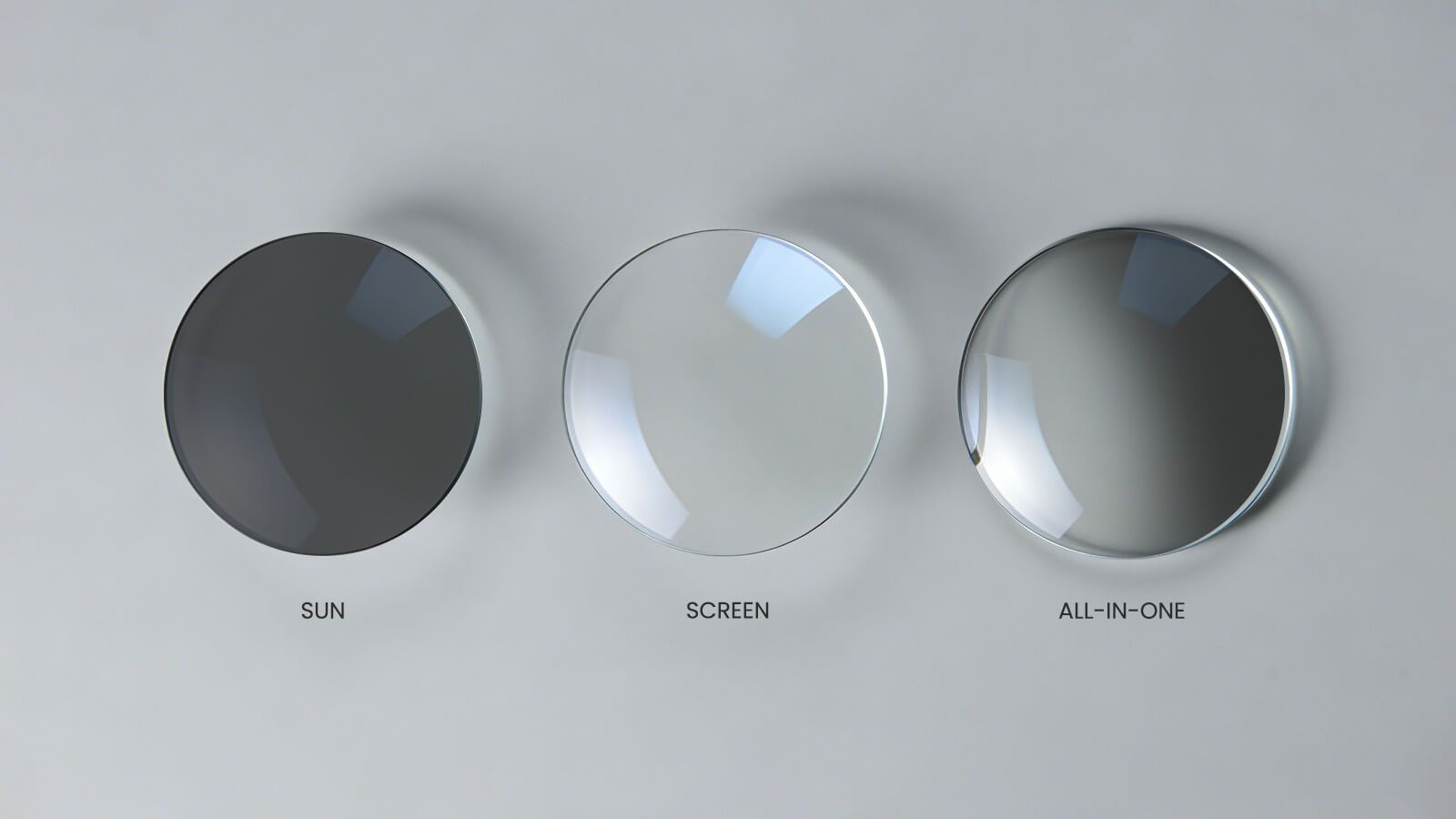
Before we dive into specific brands and lifestyle benefits, let's answer a fundamental question: what does photochromic mean? The word itself breaks down simply into "photo" (light) and "chroma" (color). In the optical world, it refers to a specific type of lens that remains completely clear indoors but darkens automatically the moment you step into the sunlight.
According to general optical principles outlined by the American Chemical Society, this seamless reaction happens because the lenses are embedded with trillions of invisible photochromic molecules. When these clever molecules are struck by the sun's ultraviolet (UV) rays, they physically change their structural shape. This new shape absorbs the ambient light, visibly darkening the lens. The moment you step back inside your art studio or a dimly lit cafe, the UV rays disappear. The molecules instantly begin returning to their original, transparent state, leaving you with crystal-clear vision.
"Transitions" vs. Photochromic: Is There a Difference?
When researching your next eyewear purchase, you will almost certainly hear people use these two terms interchangeably. So, in the ongoing debate of photochromic vs transitions, is there actually a difference? The easiest way to understand it is by thinking of facial tissues; we often call all tissues "Kleenex," even though that is just a specific brand name.
Photochromic is the scientific, generic term for light-adapting technology. Transitions® is simply the most famous, widely trusted brand that engineers these specific lenses. If you are curious about how do transition lenses work, they utilize highly advanced, proprietary photochromic dyes that outperform basic market alternatives. The technology has evolved into an entirely new generation of eyewear. Today, cutting-edge innovations like Transitions® GEN S™ offer unprecedented speed and vibrant color options that pair beautifully with a tasteful, expressive Vooglam frame.

Experience the Next Generation: Transitions® GEN S™ >>
The Pros & Cons (And How Modern Tech Solves Old Problems)
The Good Stuff (Pros)
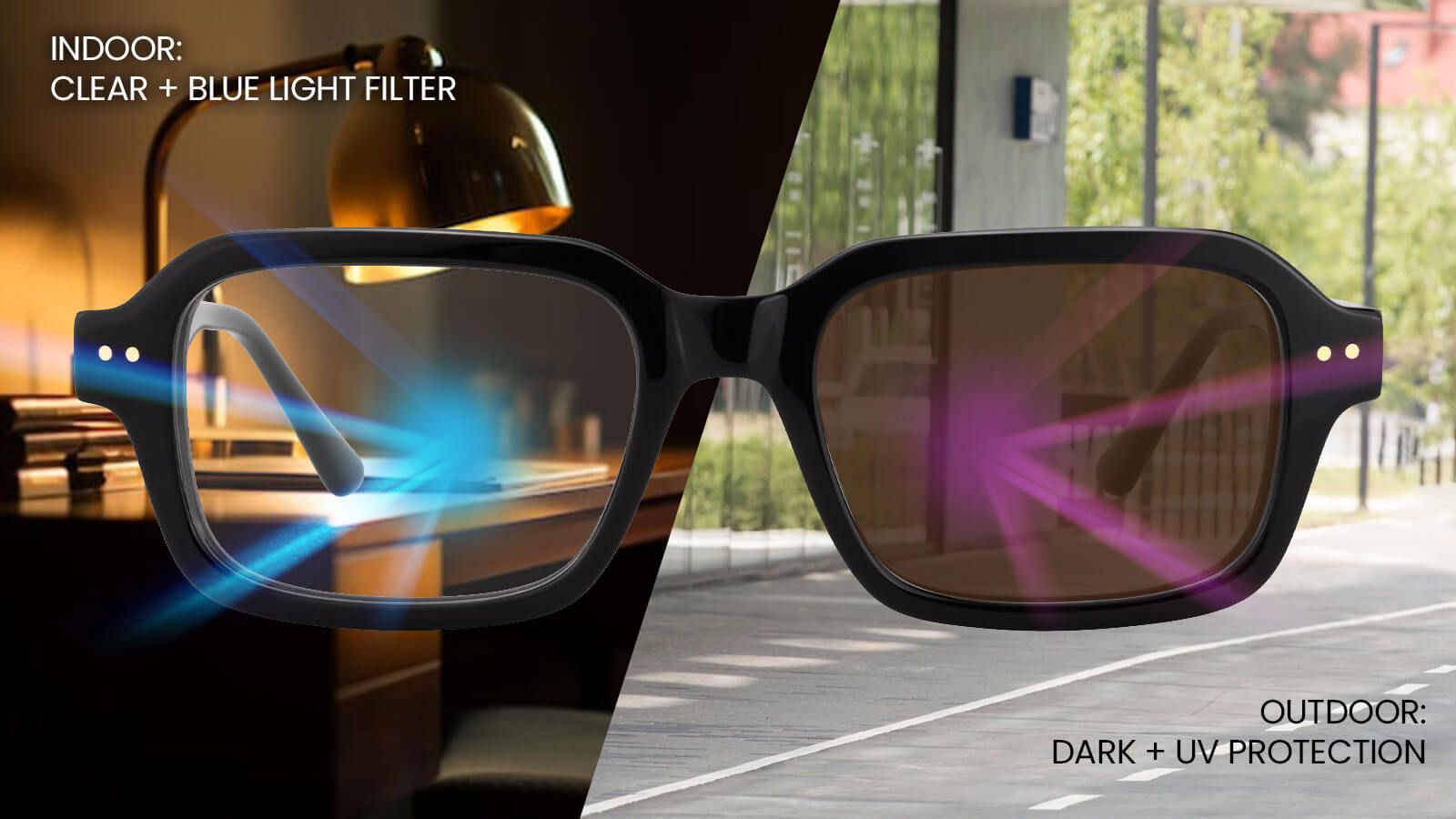
The primary benefit of light-adaptive eyewear is absolute, uncompromising convenience. You no longer need to carry multiple heavy cases or strain your eyes when moving between different environments. Beyond everyday convenience, these lenses provide a continuous, 100% shield against harmful UVA and UVB rays. Furthermore, high-quality photochromic lenses naturally filter out high-energy visible blue light, protecting you whether you are under the sun or staring at a digital monitor.
The "Old" Cons (Traditional Photochromic Limits)
Historically, design-conscious wearers had completely valid reasons to avoid this technology. Older, standard lenses suffered from the "temperature paradox," meaning they actually struggled to get fully dark on extremely hot summer days. Another major complaint was the agonizing transition time. Walking indoors, the lenses would often take several minutes to fade back to clear. This left wearers with a semi-tinted, unappealing look during indoor conversations, ruining their carefully curated style.
The "New" Solution
Thankfully, modern optical engineering has completely eradicated those outdated drawbacks. By upgrading to the newest generation, like Transitions® GEN S™, you get a premium lens designed for a fast-paced, modern lifestyle. These ultra-responsive lenses fade back to clear in mere seconds rather than minutes. Even better, they bypass the temperature paradox entirely, reaching a deeply saturated, sunglass-level darkness even during a scorching mid-summer beach trip. You get a seamless, artistic visual experience without any of the old compromises.

Customize Your Frame with Advanced Transitions Photochromic Tech >>
FAQ: Everything Else You Need to Know
Do transition lenses work as well as sunglasses?
In standard outdoor scenarios, they absolutely do. They block the exact same amount of UV radiation as premium dedicated sunglasses. However, because modern car windshields are built to block UV light, standard photochromic lenses will not darken while you are driving. If you spend hours commuting and need a lens that activates behind the wheel, we highly recommend upgrading to Transitions® XTRActive®, which cleverly reacts to visible light as well as UV.
Are they good for your eyes?
Yes, they are exceptionally beneficial. By combining outdoor UV protection and indoor digital blue light filtering, they act as an all-in-one defense system. According to the American Optometric Association, consistent UV protection is critical for preventing early-onset tissue damage and maintaining long-term eye health. With these lenses, you never accidentally leave your vital eye protection at home.
How long do they last?
The light-adapting molecules generally perform at their absolute peak for about two to three years before you might notice a slight delay in their fade time. Coincidentally, this perfectly aligns with the standard medical recommendation to update your optical prescription. When your lenses naturally reach the end of their lifecycle, it becomes the perfect excuse to explore Vooglam's latest bold designs and refresh your entire eyewear wardrobe.
Conclusion
Understanding the mechanics behind light-adaptive lenses removes all the guesswork from your next optical purchase. They elegantly blend 100% UV protection, soothing blue light defense, and effortless daily convenience into one beautifully functional package. The days of sluggish, outdated lenses are firmly behind us, replaced by technology that finally keeps up with your vibrant life.
Say goodbye to the endless swapping of frames and embrace an elevated everyday experience. Whether you prefer a subtle, clear aesthetic or want to upgrade to the lightning-fast Transitions® GEN S™, Vooglam offers the perfect canvas to express your unique identity. Explore our diverse collection of high-quality frames today, and build a pair of glasses that works exactly the way you do.
*This article is not a substitute for a professional diagnosis.
You May Also Like:
Are Transitions® GEN S Lenses Worth It? A Real-World Performance Breakdown >>
Photochromic vs Sunglasses vs Blue Light Glasses: Which Do You Actually Need? >>
Polarized vs. Photochromic Lenses: What's the Difference? >>
Lenses Made Simple: The Ultimate Guide to Types of Eyeglass Lenses >>
How to Choose the Best Lenses for Glasses: A 2026 Buyer's Guide >>

Vooglam Blog
Vooglam blog shares professional knowledge about eyeglass frames, lenses, etc., and provides help when purchasing and using eyewear products. At the same time, Vooglam focuses on fashion glasses to interpret the trend of glasses for you.