
















Guide to Picking Glasses That Suit Your Face Shape Perfectly
February 27,2023
What is Boho Style? A Comprehensive Guide to Boho-Chic Fashion
February 13,2025
Virtual Glasses Try On - Find Your Perfect Pair Online
April 02,2024
UV Protection Glasses VS. Blue Light Glasses - Vooglam
July 20,2023
Newest Style Modern Trendy Mens Glasses | Vooglam
March 01,2024
Stylish Reading Glasses: Blending Fashion with Functionality
February 16,2023
What are photochromic lenses & glasses?
September 22,2023
Brown Eyes: The Beauty of the Most Common Hue
September 01,2024
The chubby face glasses for round face female
August 02,2023
What are prisms in eyeglasses?
March 20,2023
What Are Bifocal Glasses? The Complete Guide (Types, History & Benefits)
April 14,2023
How to Read Your Eyeglass Prescription?
March 11,2023
How Do Progressive Lenses Work? The Complete Guide (Types, Cost & Benefits)
By Vooglam
Share this article

You are at a café. You open the menu, but the words look blurry. You lift your glasses up, squint, and push the menu further away. It’s frustrating.
If you are over 40, this is likely the moment your eye doctor mentions Progressive Lenses.
Often called "no-line bifocals" or "multifocals," these lenses are the modern standard for correcting vision as we age. But unlike simple reading glasses, they are a complex piece of optical engineering.
In this guide, we will break down exactly how progressive lenses work, the different types available (and which one you actually need), and whether they are worth the investment compared to standard single-vision glasses.
This article is not a substitute for a professional diagnosis.
How Do Progressive Lenses Work? (The "Hourglass" Secret)

To understand how they work, forget about traditional glasses for a second.
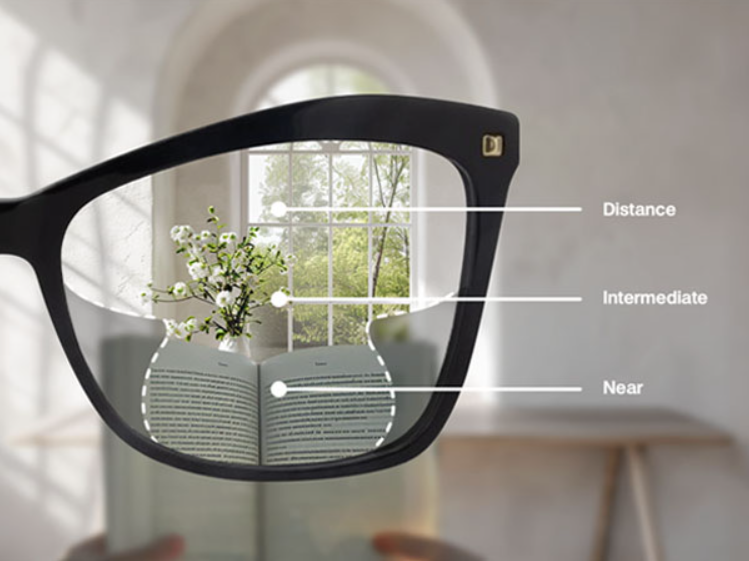
Standard lenses have one power all over. Bifocals have two powers split by a line. Progressive lenses are different. They use a seamless, vertical "corridor" of power that changes gradually from the top of the lens to the bottom.
Think of it like a camera zoom lens built into your glasses:
- The Top (Distance Zone): When you look straight ahead (driving, watching TV), the lens corrects your distance vision (whether you have myopia, hyperopia, or astigmatism).
- The Middle (Intermediate Corridor): As your eyes move down slightly, the power changes. This narrow middle zone is perfectly tuned for computer screens and car dashboards.
- The Bottom (Reading Zone): When you drop your eyes to read a text or a menu, the lens reaches its full magnification power for close-up work.
Fun Fact: The Elephant Origin
When the concept of progressive lenses first appeared around 1907 (before becoming commercially viable in 1959), the design was distinctively curved. Some early descriptions likened the design to an elephant's trunk—curved, flexible, and continuous—though today's modern progressive lenses are the result of highly advanced optical engineering.
Single Vision vs. Progressive Lenses: Do You Need the Upgrade?
The most common question we get is: "Can't I just stick with my regular glasses?"
Let’s use an analogy:
- Single Vision Lenses are like a screwdriver. They do one job perfectly. If you are nearsighted, they fix distance. If you are farsighted, they fix reading. But if you need to do both, you need to carry two different screwdrivers.
- Progressive Lenses are like a Swiss Army Multi-Tool. They handle distance, intermediate, and near tasks in one package.
You Need Progressives If:
- You find yourself constantly taking your glasses off to read small print.
- You are tired of switching between "driving glasses" and "readers."
- You want a youthful look (no visible "bifocal line" on your face).
Types of Progressive Lenses (Hard vs. Soft)

Not all progressives feel the same. Depending on your prescription and lifestyle, you might encounter different designs.
1. Hard Channel Design
- What it is: The transitions between distance and reading are short and rapid.
- Pros: It offers a wider area for distance and reading.
- Cons: The "Intermediate" (computer) zone is narrower, and the peripheral blur is harsher.
2. Soft Channel Design (The Modern Standard)
- What it is: The transition is spread out over a longer corridor.
- Pros: The change is much smoother, making it easier to adapt without feeling dizzy. In fact, most modern lenses (especially premium options) now use a digital soft or hybrid design to maximize comfort and reduce distortion.
3. Computer Progressive Lenses (Office Lenses)
- What it is: A specialized lens that removes the distance zone entirely.
- Why use it: It dedicates the entire lens to Intermediate (Screen) and Near (Paper) vision. If you are an accountant, writer, or coder, these reduce neck strain significantly because you don't have to tilt your head back to find the "computer sweet spot."
How Much Do Progressive Lenses Cost?

It is no secret: the average cost of progressive lenses is higher than single-vision or bifocal lenses. Why? Because you aren't just paying for plastic; you are paying for Digital Free-Form Surfacing.
Unlike older lenses that were molded, modern progressives are carved digitally, point-by-point, to match your specific eye movement. The price generally depends on three factors:
- The Design: Custom "Free-Form" lenses (which widen the viewing corridor) cost more than standard "Off-the-shelf" designs.
- The Material: High-Index materials (which are thinner and lighter) cost more than standard plastic but are essential for strong prescriptions to avoid thick edges.
- The Coatings: Premium Anti-Reflective and Scratch-Resistant coatings protect the complex lens surface.
Final Thoughts: The One-Pair Solution
Progressive lenses are the ultimate convenience. They allow you to drive to work, type on your computer, and read a text message—all without ever touching your frames.
While there is an adjustment period—many wearers experience a mild "swim effect" during the first few days to a week—the freedom of having clear vision at every distance is worth the short wait.
Ready to upgrade your vision? Select Progressive Lenses when customizing your next pair of Vooglam Frames and experience the world without lines.
Eyeglasses with multiple focal points can be called progressive RX glasses. They appeared in 1907. The design was inspired by the appearance of an elephant's trunk. The original purpose was to correct the vision of presbyopic patients. However, it can also be used by teenagers and adults with vision problems after constant development.

Vooglam Blog
Vooglam blog shares professional knowledge about eyeglass frames, lenses, etc., and provides help when purchasing and using eyewear products. At the same time, Vooglam focuses on fashion glasses to interpret the trend of glasses for you.









Join Our Newsletter
to enjoy more exclusive offers
Enter Your Email
SUBSCRIBE
